Define Change
What is Change?
Change is a word that often invokes feelings of excitement or apprehension, depending on your past experiences. Change exists in every aspect of life and for our generation, we are seeing this appear at a rate which has not been witnessed before. While technology is frequently the catalyst for change in our lives, the impact is far reaching into every aspect. We cannot escape it.
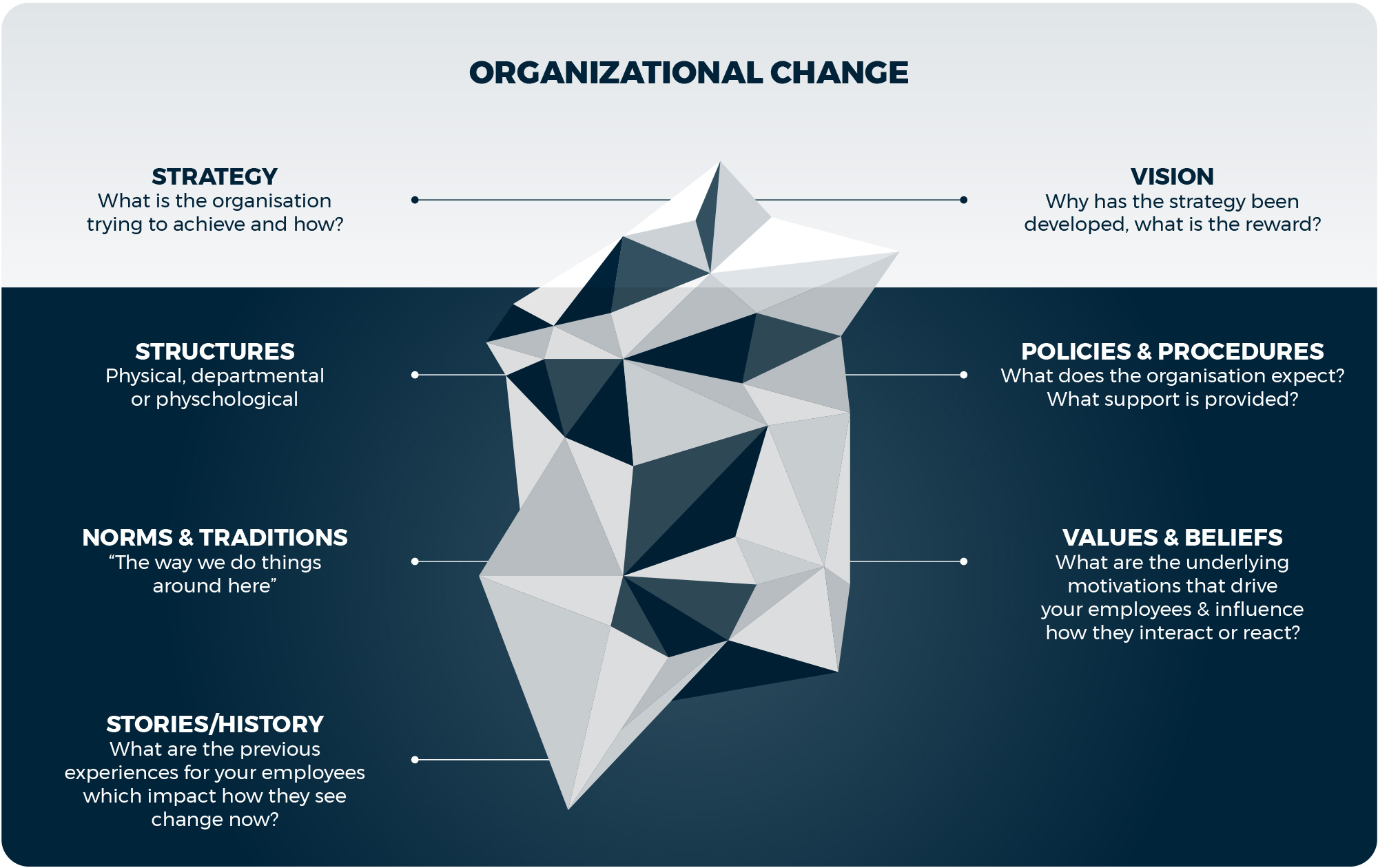
Change, in its simplest definition, is the process in which current state alters to future state. For an organisation, this is the process in which one or more components of a business move from current state to future state. Sounds simple right? Wrong. As you can see from the Iceberg Illustration, this is one of the most complex issues that any organisation faces today. It can impact our ability to function, our learned behaviours, our emotions and our sense of purpose. The outcomes from change can have even larger consequences such as financial, relational, psychological or physical impacts. It is these impacts that create fear, which drives resistance to change.
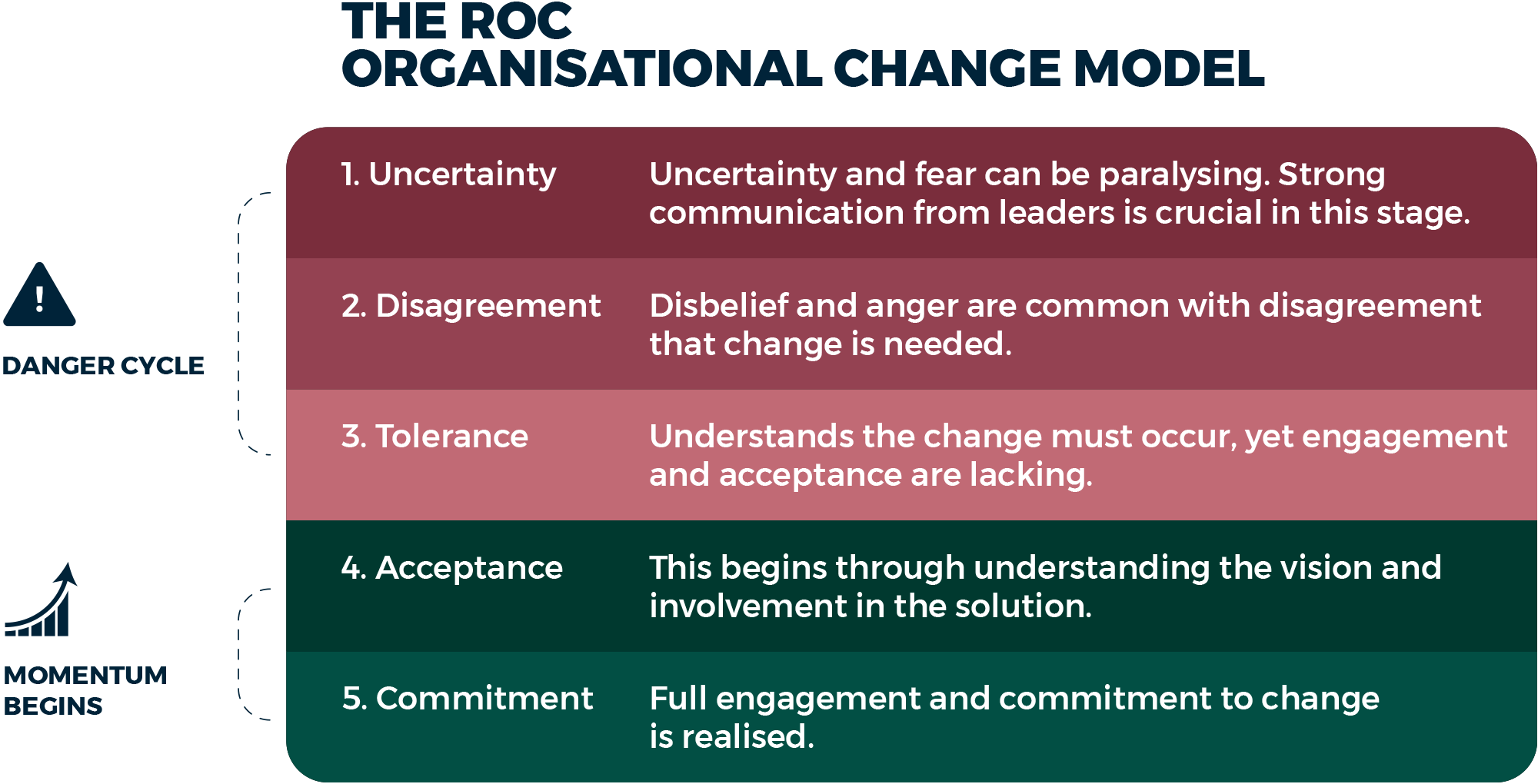
Richard Williams, an organisational psychologist, developed the Organizational Change Model to demonstrate how most people react to change. In our adapted model, whether we know it or not, change impacts us all in one way or another. Yet it is often our ability to move from Phase 1 to Phase 5 that determines our personal success in times of change.
Organisations are aware that what enabled their success in the past will not predict success in the future. They are looking to adopt change management frameworks to counteract this phenomenon. Before we look at how companies are facing this challenge, we will discuss what the issue of change is. And why.
Despite the large scale of change we’re witnessing across businesses, there is an estimated 70% failure rate on change initiatives. We can debate what drives this result and why some change is more difficult to implement than others. However, we cannot deny that managing change for successful outcomes is one of the most challenging aspects for any organisation.
Why? Because most change initiative outcomes are determined by your people. Whether it’s your leaders’ ability to cast vision, your manager’s ability to maintain productivity throughout the change, or your team’s ability to execute to the plan. Everything hinges on your people. Therefore, we must make sure we have the necessary tools and resources in place before we start the process. The consequence of not doing this well will impact your people and the culture (we all have one, whether we know it or not) for years to come, influencing outcomes for future initiatives along the way.
To address this, ROC have developed the methodology Discover, Develop, Deliver. The first step in any change process is to answer the following questions. At ROC, this is part of our Discover phase.

- WHY is there a need to change?
This is crucial to understand for two reasons. Firstly, this defines your change and articulates the problem you are looking to solve. Secondly, the WHY is what your team buy into. To gain buy-in, there must be pain to be removed and value to be added. - HOW should we categorise this change?
This question encompasses the following aspects of change:- Is the change revolutionary or evolutionary?
- Is the change planned or unplanned?
- How much resistance will there be and from where?
- What culture changes are required for successful implementation?
- WHO will manage the change process?
Are there appropriate skillsets available? This is where companies must honestly review their own capacity and capabilities to implement the necessary changes or outsource to experts in the field. - WHAT is the reward?
This one is simple. Defining the reward sets the goal. You cannot achieve what you cannot define.
In the past, many leaders were focused on the positive impact that change could bring to an organisation. There was little concern for the impact on human capital – the ends justified the means. However, this has shifted with the advent of social media and a greater emphasis on areas such as mental health, diversity and inclusion, and ethical governance.
Leaders must weigh the impact of any change on both their organisational goals, as well as impacts to their people. The businesses which will succeed into the future will be ones that do this well. Those that don’t adapt will simply be left behind.
Change Your Path
We invite you to delve deeper into the value proposition of ROC and facilitate our understanding of your unique needs. Schedule a Discovery session with our expert team via Calendly today.
About
At ROC, we meticulously craft strategies tailored to your unique journey.
Our core lies in rapidly pinpointing your challenges and devising tailored strategic responses, whilst maintaining a clear focus on your overarching objectives.
Discovery Sessions
Looking to change your company structure, corporate culture or want to introduce a new system or product.
Please contact us to discuss your needs and we will help point you in the right direction.